
Gilmore City Records Starting Point
Gilmore City counted 487 residents in the 2020 incorporated-place figures. That number describes the town, nothing more. It predicts nothing about warrants, arrests, or safety, and no official Gilmore City warrant total exists to check it against. So start with whatever paper is already in hand. A citation, hearing notice, payment reminder, or agency letter names the county and the issuer outright. No paper? Use the official state docket and search deliberately. Write down the URL, the date, the case number, the citation number, the county, the latest event, and the office contacted. Those notes make the follow-up call precise and short.
Pick the county before running any broad name search. Humboldt belongs in the query only if the filing belongs to Humboldt. A hit filed in another county goes to that county's clerk, even when the address is in Gilmore City. This keeps a resident from asking the Humboldt clerk to explain a Pocahontas filing, or asking City Hall to perform district court work. Timing matters too. Court data appears after filing and then gets updated, and a citation can take up to two weeks or more to show. Confidential and juvenile matters never display. When nothing comes back, check spelling and prior names, allow for posting delays, and call the proper clerk. Silence from the public portal never proves that no warrant exists.
Gilmore City Warrant Checks
Gilmore City runs no police warrant desk, online city warrant list, or separate municipal criminal court portal. So begin with the official notice in hand. Write down the issuing agency, the citation or case number, the event date, and the county. The county field does the heavy lifting here. A Gilmore City address alone cannot tell you whether the case was filed in Humboldt or Pocahontas County.
- Read the notice for the issuing city, agency, filing county, and required date.
- Search Iowa Courts Online by case ID, citation number, or a carefully matched name.
- Contact the clerk in the county shown on the case for the official court record.
- Call the correct sheriff for a service question, not for legal advice.
- Ask counsel about appearance, recall, bond, or another lawful resolution step.
Gilmore City’s Two-County Test
The official Gilmore City emergency-services page names both the Humboldt County Sheriff and the Pocahontas County Sheriff. Treat it as a routing clue, not a warrant database. It simply shows why the city name cannot tell you where the court file sits. Test jurisdiction with three details: the county printed on the citation, the county selected in Iowa Courts Online, and the agency named on the notice. If those conflict, call the clerk listed in the official court directory before sharing anything personal. Humboldt County's sheriff answers at 515-332-2471. The city lists Pocahontas County's sheriff at 712-335-3308. Emergencies still go to 911.
Key point: A Gilmore City address does not by itself prove that Humboldt County holds the warrant record.
Policing and Courts in Gilmore City
City sources name no Gilmore City police warrant portal and no local municipal criminal clerk. Under Iowa's unified district court system, a criminal or state traffic matter goes to the clerk of the county where it was filed. A sheriff or another peace officer may handle service. City Hall still earns a call for city administration, ordinance records, and the parking notices it keeps. Gilmore City Hall sits at 304 South Gilmore Street, P.O. Box 276, Gilmore City, IA 50541. Its contact page lists 515-373-6326, fax 515-373-6314, and cityhall@gilmorecityiowa.com. Weekday hours run 8:00 a.m. to noon and 12:30 p.m. to 4:30 p.m. Ask City Hall about its own records, not about certifying a district court warrant.
No Gilmore City Warrant Portal
Gilmore City publishes no warrant list, municipal criminal docket, or city police roster. That absence has a payoff: stop hunting for an unverified city database, and never treat an ad as the official search. The real route starts with Iowa Courts Online, which offers basic public case information free of charge. It is not the official court record, though. Confidential and juvenile cases stay out, and a new citation can take 10 to 14 days to post. From there, contact the clerk in the filing county. Call the sheriff only when the question is service, or which agency holds an active warrant.
Warrants in Gilmore City: The Main Types
Gilmore City does not publish its own warrant list, so residents meet these orders through other offices. Where a matter was filed decides who handles it. A search warrant lets officers search a place, and it is not an arrest order. A missed court date creates a failure to appear, or FTA, which can produce a bench warrant.
| Warrant Type | How It Arises | Who Issues It |
|---|---|---|
| Traffic-related FTA | Required traffic appearance was missed | Iowa District Court judge or magistrate |
| Bench or FTA warrant | Required court event or order was missed | Judge or magistrate in the existing case |
| Arrest warrant | Complaint, affidavit, indictment, or information | Iowa judge or magistrate |
| Search warrant | Probable cause supports a search | Authorized judicial officer |
Gilmore City Citation-to-Court Route
Everything starts with the notice itself. A Gilmore City parking or ordinance ticket usually stays at City Hall, while a state traffic or criminal citation gets filed in Iowa District Court. Once it lands there, the county clerk keeps the docket and every court document. If you miss a required date and a failure-to-appear warrant issues, the clerk sends it on under the process Iowa law sets. Hold onto the exact citation number and its date. Run any search after the public system's posting delay, since new entries do not appear instantly. Paying online is a trap for the unwary, because settling a fine does not automatically recall the warrant. A required appearance or a judge's order can still be open even after the debt is paid. Ask the clerk directly which event changes the warrant status, and get the details on how that change will show up in the docket.
Gilmore City Warrant Records: What They Show
A public court result for a Gilmore City case shows the jurisdiction, the case number, the charge, dates, and posted events. The full warrant and its supporting affidavit may stay out of view. Iowa Code section 804.29 allows arrest-securing information to remain confidential until arrest and the officer's return or initial appearance. Treat the public result as a lead, not a full file.
Write down the latest event date. When public access allows, request the official document from the county clerk for the Gilmore City case.
Gilmore City Hall’s Proper Role
Gilmore City's official contact page is the verified local route for city administrative questions. City staff can identify a city notice, office, or municipal record. That page is not an arrest-warrant database. It cannot substitute for the Iowa Judicial Branch. The official contact screen lists the hours and channels residents need to reach a verified source.
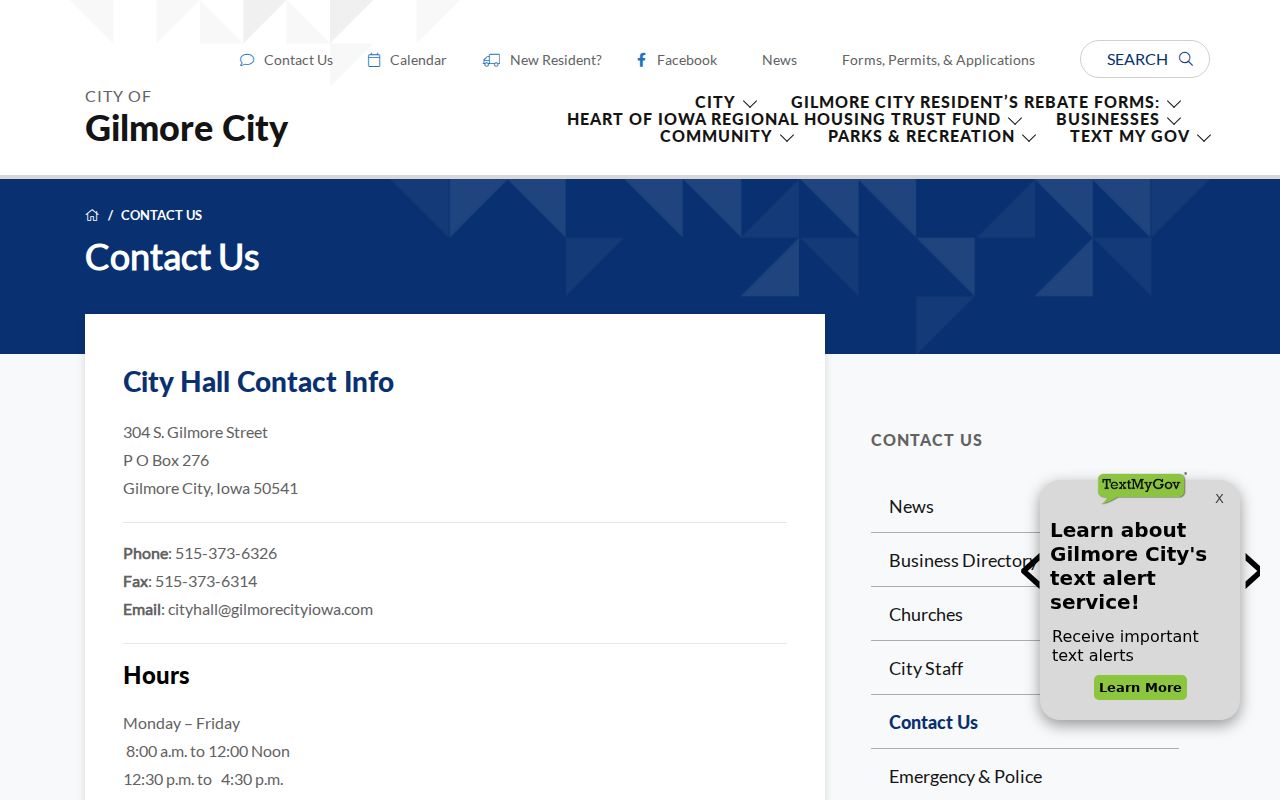
A notice naming a district court case belongs with the county clerk, so bring the case number there. If it names a sheriff, confirm the county first.
Gilmore City Warrants and Humboldt County
A Gilmore City matter filed in Humboldt County goes onto the Iowa District Court docket kept by the Humboldt County Clerk of Court. The sheriff or another peace officer serves the warrant. Iowa's IOWA System links criminal-justice agencies, but the public cannot search it. The Humboldt County warrant records overview maps the county-wide route.
Warrant flow: Gilmore City notice or agency › filing-county clerk › serving peace officer › nonpublic IOWA System
A filing in Pocahontas County stays there. The Humboldt clerk does not take over just because Gilmore City sits in Humboldt's geography. Follow the filed county shown in the official docket.
Gilmore City Same-Name Safeguards
A name search can pull up a stranger. Someone with a common name in Gilmore City should check spelling first. Then compare the county, case type, exact date of birth, citation number, and filed date. Iowa Courts Online warns about prior names, misspellings, and the zero-versus-letter-O problem in a case ID.
- Case ID
- The court identifier used to trace one filing.
- FTA
- Failure to appear at a required event.
- Recall
- A judicial act withdrawing a warrant.
- Return
- An officer’s report concerning execution of the warrant.
Helping a relative? Let that person join the call when an office needs identity or authorization. Keep the record private.
Accessing Gilmore City Warrant Records
Iowa law and Judicial Branch policy back public access, but access has limits. The right custodian depends on the record. Gilmore City holds its city records. The clerk in the filing county holds district court documents. A sheriff controls records in its custody, subject to confidentiality and operational rules.
Key Rules:
Iowa Code chapter 22, Examination of Public Records supports examination of public records while preserving legal exceptions.
Iowa Code section 804.29 keeps arrest-securing information confidential until its statutory release point or a court order.
Iowa Courts Online excludes confidential and juvenile cases, and its remote result is not the official court record.
State the case, document, and filing county in any request to a Gilmore City office or clerk. Copy, review, redaction, postage, and staff-time charges may apply. Clerks cannot do open-ended research.