
How Arrest Warrants Work in Humboldt County
Every arrest warrant in Humboldt County traces back to a legal showing. Iowa Code section 804.1 sets the starting point: a complaint or affidavit alleging facts that support probable cause. That probable cause is the factual engine of the warrant. A magistrate reviews it and decides whether a warrant should issue, or whether a citation fits the circumstances better. An indictment or information works differently as a charging instrument, but Iowa court rules let it lead to an arrest warrant too. Either way, the case lands in the Iowa District Court, Judicial District 2. The warrant itself tells a peace officer to arrest the named or described person and bring that person before the proper court or magistrate. A charge remains an allegation.
Humboldt County Complaint-to-Warrant Path
A Humboldt County warrant record builds in layers. First comes the complaint or sworn affidavit. A magistrate reviews the showing, and if a warrant issues, it goes to a peace officer. That officer may execute it in any Iowa county, and the arrested person must get an initial appearance without needless delay.
- Complaint or affidavit alleges the offense and supporting facts.
- Magistrate reviews probable cause and chooses warrant or citation.
- Clerk records the court action and related filings.
- Peace officer receives authority to execute the warrant.
- Return and initial-appearance events enter the court process.
An indictment or information is a different charging route in Humboldt County. It can still end in a court-issued arrest command.
Arrest Warrants: What They Contain
Iowa Code section 804.2 and Iowa Rule 2.36 set the required fields. They name the defendant, the offense, and the issuing magistrate. A public Humboldt County docket may show only part of this.
A Humboldt County warrant on an indictment or information adds the charging context. It also tells the officer where to bring the person.
Humboldt County Record Layers
A Humboldt County case file is a stack of distinct records: complaint, affidavit, warrant, bail endorsement, return, docket event, and disposition. Iowa Code section 804.29 lets information filed to secure an arrest warrant stay sealed until arrest and officer return or initial appearance, whichever comes first. That is why a public case can exist with no downloadable affidavit. Start with Iowa Courts Online for basic docket information. Then ask the Humboldt County clerk for a public document tied to the exact case number, since the free result is not the official record and may omit protected or juvenile matters.
How Warrants Get Served in Humboldt County
Service rules come from Iowa Code sections 804.4 and 804.6. A warrant may be delivered to a peace officer and served in any Iowa county, and only a peace officer may execute it. County lines do not cancel the authority. A Humboldt County warrant stays live wherever in Iowa the person is found. The Humboldt County Sheriff, at 430 Sumner Avenue in Humboldt, is the local service contact at 515-332-2471. The office posts no online warrant list and no separate warrant-unit number. Call and ask whether the sheriff is the serving agency and how to arrange safe contact. Understand the likely custody and court process before you show up in person.
Humboldt County Clerk and Sheriff Roles
The Humboldt County Clerk of Court keeps the district court records at P.O. Box 100, Dakota City, IA 50529. The office number is 515-332-1806 and the fax is 515-332-7100. Ask the clerk about filings, docket events, scheduled hearings, and copies; staff explain procedure but cannot pick a legal strategy. The sheriff handles service and agency questions. The court alone controls its warrant and bail orders. An attorney advises on surrender, appearance, bond, or a motion. Keeping those Humboldt County roles straight saves wrong-office calls and risky assumptions.
Arrest Warrants, Summonses, and Bench Warrants
These documents are cousins, not twins. A new arrest warrant follows probable cause or a charging instrument. A citation or summons tells a person to appear, without immediate warrant service. A bench warrant, or failure-to-appear warrant, comes from a missed duty in a Humboldt County case already open.
| Process | Common trigger | Immediate instruction |
|---|---|---|
| Arrest warrant | Probable cause, indictment, or information | Peace officer arrests and brings person to court |
| Citation or summons | Charging path allowed without arrest warrant | Appear as directed |
| Bench or FTA warrant | Missed appearance or court order | Resolve through issuing court |
Iowa dockets in Humboldt County do not use the term "capias pro fine." Read the actual docket term instead.
Humboldt County Bail Endorsements
Section 804.3 lets a judge put a bail endorsement right on an arrest warrant in Humboldt County. The endorsement can set a dollar amount or attach conditions, but each one is case-specific. When court is not in session, the statewide Uniform Bond Schedule covers certain nonforcible felony and misdemeanor matters. Other listed offenses wait for a judicial officer before any bond is set. Do not guess the amount from a charge name or an old schedule. Ask the court to confirm the current endorsement, and get a lawyer if custody is likely. An appearance bond only secures a future court date. It does not resolve the underlying criminal case.
When a court acts, release terms can shift quickly. Iowa Code chapter 811 sets the rules for conditions of release, and section 804.21 requires an initial appearance without unnecessary delay before the nearest accessible magistrate. There the court takes up the charge, the right to counsel, and the bond or release framework. A bond schedule used while courts are closed never substitutes for that judicial review. Before you go, gather the verified case number, the actual warrant or docket event if it is public, and advice that fits the charge.
Humboldt County's system is small, but its warrants travel. An officer may execute an Iowa warrant outside Humboldt County, so sitting in another Iowa county proves nothing about whether the warrant is active. If the person is out of state, or the charging document is unclear, let counsel identify the right court contact before anyone makes an uninformed trip. Keep the confirmed case number handy. Save the date you checked. Keep every new court notice. A relative calling on someone's behalf may need that named person on the line when identity or authorization rules apply.
Handling an Arrest Warrant in Your Name
Start by confirming the identity, the case number, the court, and the current public event. A same-name hit alone proves nothing. Ask the Humboldt County clerk whether a hearing or filing is on record. Ask the sheriff only about service. Counsel can weigh whether the next lawful step is a scheduled appearance, a surrender, an initial appearance, a bond request, or another filing.
Plan first: A voluntary appearance can still lead to custody, so confirm the official case and obtain advice before traveling.
Keep every notice and order you receive. Once the court acts, check the official Humboldt County record again. A portal label like "disposed" does not by itself confirm current warrant status.
Humboldt County Arrest Scam Warning
The 2026 Iowa Judicial Branch alert warns about fake callers and texts claiming a warrant, a missed hearing, or unpaid court debt. They push prepaid cards, cryptocurrency, or sensitive identifiers. Officers never collect court fines or fees. The alert below reinforces the point: hang up and call the Humboldt County clerk or sheriff on a number you already know.
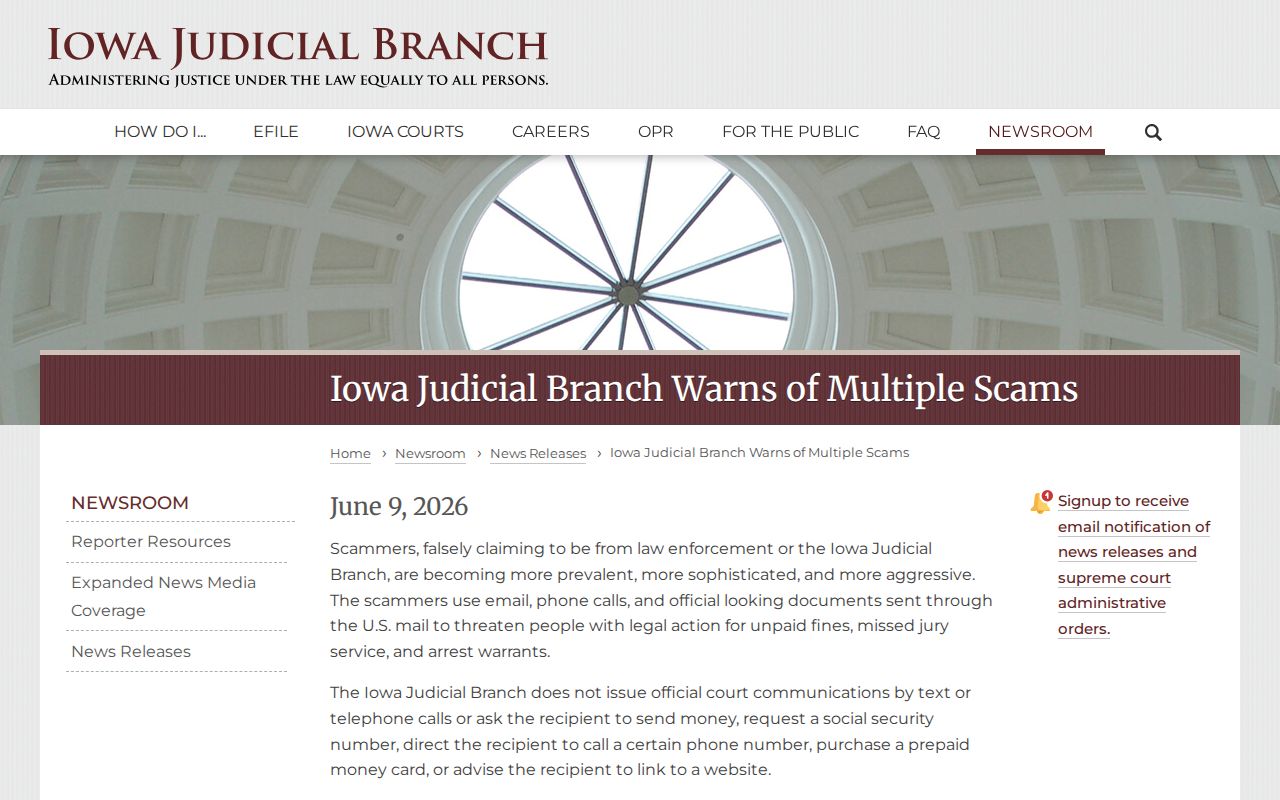
Real payment runs through the clerk, secure ePayment, or the Judicial Branch payment phone route. Paying never replaces checking whether the Humboldt County court has recalled the warrant.